
Swanson Reed’s Academic Research
Introduction to Singapore’s R&D Tax Measures
Singapore’s commitment to becoming a global hub for innovation is anchored by a suite of tax incentives designed to reduce the financial burden of R&D. The cornerstone of this policy is the Enterprise Innovation Scheme (EIS), a comprehensive framework that significantly enhances the tax benefits available to companies undertaking innovative activities within the city-state.
The Enterprise Innovation Scheme (EIS)
Introduced in Budget 2023 and effective for the Years of Assessment (YA) 2024 to 2028, the EIS consolidates and enhances previous R&D incentives into a more potent and accessible scheme. The primary benefit for companies conducting qualifying R&D in Singapore is a tiered system of enhanced tax deductions. Businesses can claim a 400% tax deduction on the first $400,000 of qualifying expenditure incurred per year.This comprises a $100400,000 cap, businesses can still claim a 250% deduction (a 100% base deduction plus a 150% enhanced deduction under Section 14D).
A crucial feature of the EIS is the optional cash payout, designed to support startups and small to medium-sized enterprises (SMEs) that may be in a pre-profitability phase. Eligible businesses can make an irrevocable election to convert up to S$100,000 of their total qualifying expenditure across all qualifying activities (including R&D) into a non-taxable cash payout. The conversion rate is 20%, resulting in a maximum cash benefit of S$20,000 per YA. Eligibility for this option is contingent on meeting specific criteria, most notably the “3 full-time local employee condition,” which requires the business to have made Central Provident Fund (CPF) contributions for at least three local employees for a minimum of six months during the relevant basis period.
This dual-track structure of the EIS presents a strategic financial decision for businesses. The choice is not merely between a deduction and a credit; it is a calculated decision based on the company’s financial position and strategic outlook. For a profitable company subject to the 17% corporate income tax rate, a $100,000 expenditure yielding a $400,000 deduction translates into a tax saving of S$68,000 ($400,000 \times 17\%$). This is substantially more valuable than the S$20,000 cash payout. However, for a loss-making startup, a future tax saving has little immediate value compared to a non-dilutive cash injection that can fund operations and further innovation. The irrevocability of this choice for a given YA means that the R&D claim process must begin with a thorough analysis of the company’s profitability, projected income, and immediate cash flow requirements, making it a strategic decision for the C-suite, not just a compliance task for the tax department.
Qualifying R&D and Qualifying Expenditure
To access these benefits, a company’s activities must first meet the statutory definition of R&D as outlined in Section 2 of the Income Tax Act 1947. This definition is operationalized through a “three-pillar test,” which requires a project to have a clear Objective, involve Novelty or Technical Risk, and be conducted as a Systematic, Investigative, and Experimental (SIE) Study.
Once an activity qualifies as R&D, the associated costs must fall under the definition of Qualifying Expenditure. For R&D conducted in-house in Singapore, this primarily includes staff costs (salaries and other remuneration, excluding directors’ fees) for employees directly engaged in the R&D activity, and the cost of consumables (materials and supplies consumed during the R&D process). For R&D outsourced to a third-party service provider, the qualifying expenditure is generally calculated as 60% of the fee paid to the provider.
The Substantiation Challenge
The central challenge for taxpayers in Singapore lies in substantiating their claims to the satisfaction of IRAS. Unlike the United States tax system, where decades of court cases have created a body of public precedent that informs taxpayers on what constitutes sufficient documentation, the Singaporean system is governed primarily by IRAS’s administrative interpretation. There is no public repository of tax court rulings on R&D claims that businesses can study. This creates a “documentation vacuum” where taxpayers cannot simply react to established legal standards. Instead, they must proactively construct a robust and logical evidentiary file based on the principles and examples provided in IRAS’s own publications. This report aims to fill that vacuum by providing a practical framework for building such a file.
ARE YOU ELEGIBLE?

WHY CHOOSE US?

PASS AN AUDIT?

A Detailed Analysis of the Qualifying R&D Rules (The Three-Pillar Test)
The eligibility of any R&D tax claim in Singapore hinges on whether the underlying project satisfies the three-pillar test. Each pillar represents a distinct criterion that must be met and, more importantly, documented. A failure to substantiate any one of these pillars can jeopardize the entire claim.
- Pillar 1: The Objective
- Pillar 2: Novelty or Technical Risk
- Pillar 3: The Systematic, Investigative, and Experimental (SIE) Study
The first pillar requires that the project’s primary purpose is clearly defined and falls within the scope of innovation. Specifically, the objective must be to acquire new knowledge, create a new product or process, or significantly improve an existing product or process.
A critical requirement under this pillar is that the objective must be clearly articulated before the commencement of the project.This means that activities undertaken to determine if a project is feasible, such as initial market research or a preliminary economic analysis, do not qualify because they precede the formulation of a specific scientific or technological objective. The documentation must demonstrate that the company identified a specific gap between the current state of knowledge or technology and the desired outcome, and that the R&D project was initiated with the express purpose of closing that gap.4 For example, an objective stated as “to increase market share” is a commercial goal, not an R&D objective. A qualifying objective would be “to develop a new chemical process that reduces manufacturing time by 50% by overcoming current catalyst deactivation issues.”
This pillar is arguably the most critical and often the most challenging to substantiate. The project must involve an element of novelty or, more commonly, address a technical risk. This concept is defined by IRAS as a “scientific or technological uncertainty that cannot be readily resolved by a competent professional in the relevant field”.
This definition sets a high bar. It is not enough for a project to be new to the company or even new to Singapore if the solution is readily deducible using existing knowledge and standard industry practices. The core of this pillar is the presence of genuine uncertainty. Examples of activities that may satisfy this test include:
- Integrating two or more technologies for the first time, where the outcome of the integration is uncertain.
- Using existing technology to produce new goods or deliver services in fundamentally new ways.
- Developing a new process to manufacture a product, even if the final product itself is not new.
- Fundamentally changing the physical characteristics of a product, beyond cosmetic alterations.
The phrase “not readily resolved by a competent professional” is the true gatekeeper of the R&D incentive. It fundamentally shifts the nature of the required documentation and the internal processes needed to generate it. While the “Objective” and “SIE Study” pillars are largely procedural—requiring evidence of planning and systematic execution—the “Technical Risk” pillar is substantive. It compels the taxpayer to prove a negative: that the solution was not obvious, not straightforward, and not achievable through the application of standard engineering or scientific principles.
This has profound implications for how a company should prepare its R&D claim. The claim ceases to be a simple accounting exercise of tallying salaries and material costs. It transforms into a technical thesis, where the central argument is the inherent difficulty of the problem being solved. The primary evidence is no longer financial ledgers but technical documents: literature reviews, patent searches that show a lack of prior art, detailed records of failed experiments, and expert opinions that attest to the project’s challenges. Consequently, the primary authors of the R&D claim’s justification must be the engineers and scientists who lived the uncertainty. The finance and tax teams play a crucial, but supporting, role in costing the activities and structuring the claim. This reorientation is essential for building a defensible position that can withstand IRAS scrutiny.
The final pillar mandates that the R&D activity must be conducted in a structured and methodical manner. It must be a “Systematic, Investigative, and Experimental study in a field of science or technology”. This requirement distinguishes genuine R&D from ad-hoc problem-solving or random trial and error.
The key elements of an SIE study include:
- Systematic: The work must follow a logical progression based on a plan. This often involves iterative processes where hypotheses are formulated, tested, and modified based on the results.
- Investigative: The activities must be designed to explore and uncover new information to resolve the technical uncertainties identified under the second pillar.
- Experimental: The project must involve a series of structured steps to test potential solutions. This can include modeling, simulation, prototype development, and systematic trial-and-error methodologies.
Crucially, the outcome of the project is irrelevant to its qualification. R&D tax benefits can be claimed regardless of whether the project was successful. In fact, well-documented evidence of unsuccessful attempts and the steps taken to learn from them can be a “persuasive indicator that the outcome is not readily deducible,” thereby strengthening the claim under the “Technical Risk” pillar. The entire process, from initial hypothesis to final conclusion—including all failures along the way—must be documented to demonstrate that a rigorous SIE study was undertaken.
Specifically Excluded Activities
To provide clarity and prevent the misapplication of R&D incentives to routine business operations, IRAS explicitly lists several activities that do not qualify as R&D, even if they are conducted in support of a broader innovation agenda. Understanding these exclusions is critical for accurately scoping a claim and avoiding potential disputes with IRAS.
The primary excluded activities are 5:
- Quality control or routine testing of materials, devices, or products: This includes tests to ensure existing products meet manufacturing standards or regulatory requirements, as well as the calibration and fine-tuning of existing production systems.
- Research in the social sciences or the humanities: The R&D incentives are strictly focused on advancements in science and technology.
- Routine data collection: This is distinct from the data collection that forms part of a systematic experiment.
- Efficiency surveys or management studies: These are considered general business improvement activities.
- Market research or sales promotion: Activities aimed at understanding customer preferences or marketing a product are commercial, not technical, in nature.
- Routine modifications or changes: Minor adjustments to products or processes that do not seek to resolve a scientific or technological uncertainty are excluded. An example would be slightly altering the flavor profile of a food product.
- Cosmetic or stylistic changes: Modifications that affect the appearance of a product without changing its underlying technology or functionality, such as creating a new color or shape for a product casing, are not considered R&D.
- Research after commercial production: Once a product or process is in commercial use, subsequent activities are generally not considered R&D unless they are part of a new project to create a fundamentally improved version that meets the three-pillar test.
The distinction between qualifying R&D and these excluded activities can often be subtle. The following table provides contrasting examples to illustrate the practical application of these rules.
| Industry | Qualifying R&D Activity | Non-Qualifying (Excluded) Activity | Rationale for Distinction |
| Software Development | Developing a novel machine learning algorithm to predict network failures with 99.9% accuracy, involving uncertainty in model architecture and training data optimization. | Integrating an off-the-shelf machine learning library into an existing monitoring tool to add a predictive feature using standard, documented implementation methods. | The qualifying activity involves resolving fundamental uncertainty in how to achieve the result. The non-qualifying activity uses known tools and methods to achieve a predictable outcome. |
| Advanced Manufacturing | Experimenting with a new, untested metallic alloy to create a lighter and stronger component, facing significant uncertainty in material properties, casting temperatures, and fabrication techniques. | Calibrating existing machinery to work with a new, commercially available grade of steel that has known properties and manufacturer-supplied processing guidelines. | The qualifying activity addresses unknown material behaviors (“technical risk”). The non-qualifying activity is a routine operational adjustment (“routine modification”). |
| Food Technology | Developing a new plant-based protein that mimics the texture and taste of meat by experimenting with novel protein extraction and extrusion techniques, facing uncertainty in achieving the desired molecular structure. | Reducing the sugar concentration in an existing beverage formula to create a “less sweet” version, involving simple adjustments to the ingredient mix. | The qualifying activity seeks to create a fundamentally new product through scientific experimentation. The non-qualifying activity is a “routine modification” without technical uncertainty. |
| Biotechnology | Conducting pre-clinical trials on a new drug compound to determine its efficacy and safety profile, facing uncertainty about its biological interactions and therapeutic effects. | Performing routine quality control tests on a batch of an approved, commercially produced drug to ensure it meets regulatory standards for purity and concentration. | The qualifying activity is part of the discovery process to resolve scientific uncertainty. The non-qualifying activity is “quality control” on a known product. |
This table translates the abstract definitions from IRAS guidance into concrete, relatable scenarios. By placing qualifying and non-qualifying examples side-by-side, it highlights the single most important differentiator: the presence or absence of technical uncertainty. This provides a practical tool for tax managers and engineers to self-assess their projects, moving beyond regulatory language to clear operational guidance.
NEVER MISS A DEADLINE

STAY UP TO DATE ON IRS PROCESS

DISCOVER R&D IN YOUR INDUSTRY

IRAS’s Focus on Substantiation: An Analysis of Administrative Guidance
In the absence of a public body of tax court precedents for R&D claims in Singapore, taxpayers must look to IRAS’s administrative pronouncements and frameworks to understand its expectations for substantiation. These resources, while not legally binding in the same way as a court ruling, provide the clearest available insight into the standards against which a claim will be judged during a review or audit.
“Research and Development Tax Measures”
The foundational text for any R&D claim is the IRAS e-Tax Guide titled “Research and Development Tax Measures”. This guide is the primary source of official interpretation, providing detailed explanations of the three-pillar test, definitions of qualifying expenditure, and illustrative examples. For instance, the guide contains specific examples related to software development, which is an area that IRAS notes often requires more information from taxpayers due to its complexity. Taxpayers and their advisors should treat this guide as the starting point and primary reference for structuring their R&D claims and documentation.
A Blueprint for Best Practices
While the e-Tax Guide explains the “what,” the R&D Assurance Framework provides a clear indication of the “how.” This framework is an initiative that allows taxpayers with significant and consistent R&D activities to apply for upfront certainty on their claims for up to three Years of Assessment.15 Eligibility requires a company to have at least five in-house R&D projects and qualifying expenditure of at least S$500,000 in the year of application.
However, the true value of the framework extends to all taxpayers, not just those who apply. The application form for the R&D Assurance Framework effectively serves as a public statement of IRAS’s “gold standard” for internal controls and documentation. A careful analysis of the application’s requirements reveals a detailed checklist of best practices. Key requirements include:
- A Documented Evaluation Process: The applicant must declare that it has “a documented evaluation process for evaluating whether non-routine projects meet the conditions of the R&D Tax Measures”.6 This points to the need for a formal, written internal procedure for identifying and vetting potential R&D projects.
- Contemporaneous Documentation: The form explicitly requires confirmation of “contemporaneous documentation to show how the expenses for qualifying R&D projects are identified and accounted for”.6 This signals that records created after the fact are viewed with skepticism; the best evidence is that which is generated in real-time as the R&D work progresses.
- Specific Record-Keeping: The application demands sample records to demonstrate cost tracking, providing examples such as “Timesheets to verify the amount of time spent on R&D (vs non-R&D) activities” and “Cost breakdown and invoices to link other expenses to R&D”.
- Comprehensive Project Listing: Applicants must provide a complete list of all projects undertaken, both those claimed as R&D and those considered routine, to demonstrate a clear and defensible selection methodology.
This framework’s application form is, in essence, a compliance blueprint available to all. While the US system requires taxpayers to analyze complex court cases to infer documentation standards, Singapore’s system provides a more direct, if less widely understood, roadmap. A prudent taxpayer can reverse-engineer these requirements to build an audit-proof documentation file from the ground up. By structuring internal R&D project management and accounting systems to align with the framework’s application criteria, a company can proactively address the very questions IRAS is likely to ask during a review, significantly strengthening its claim and minimizing compliance risk.
For particularly complex or contentious cases, IRAS may refer a claim to its Technical Advisory Panel for review. This panel consists of experts from various scientific and technological fields who advise IRAS on the technical merits of a claim. The existence and use of this panel further underscore the technical, rather than purely financial, nature of the R&D claim review process. It reinforces the necessity for documentation to be not only financially accurate but also scientifically robust and clearly articulated in a way that a technical expert can understand and validate. This reality places a premium on the quality of technical write-ups, lab notebooks, and other evidence that speaks directly to the project’s scientific or technological challenges.
Insights from Singapore Case Law
As previously noted, Singapore’s R&D tax framework is primarily shaped by the administrative guidance of IRAS rather than an extensive body of public court rulings. However, key tax cases, while not always directly about R&D, establish foundational principles that are critical for substantiating any tax deduction claim, including those for R&D. These cases illuminate the judiciary’s approach to interpreting the Income Tax Act and underscore the high evidentiary burden placed on taxpayers.
ABD Pte Ltd v Comptroller of Income Tax 3 SLR 609 (HC)
The Capital vs. Revenue Distinction
A fundamental issue in tax law is distinguishing between capital expenditure (costs to acquire or improve a long-term asset) and revenue expenditure (day-to-day operational costs). Generally, capital expenditure is not deductible against income. The High Court in ABD Pte Ltd affirmed the principle that expenditure is considered capital in nature if it is incurred to create, improve, or strengthen an enduring asset or to open up a new field of trade. This principle is highly relevant to R&D, as successful R&D often results in the creation of an enduring capital asset, such as a patent or other intellectual property. While R&D expenditure could be viewed as capital, the Income Tax Act provides specific statutory provisions (Sections 14C and 14D) that explicitly permit deductions for such spending, recognizing its importance for innovation. This case highlights the underlying capital nature of some R&D outcomes and reinforces the need to rely on these specific statutory allowances for deductibility.
Pinetree Resort Pte Ltd v Comptroller of Income Tax 3 SLR(R) 136
The “Nexus to Trade” Requirement
For an expense to be deductible under Section 14(1) of the Income Tax Act, it must be incurred “in the production of income.” The Pinetree Resort case is important for its interpretation of this “nexus” requirement. The Court of Appeal stated that “in determining whether the nexus is present, the business has to be looked at as a whole set of operations directed toward producing income”. This principle is particularly crucial for R&D claims. R&D is often exploratory and may not be linked to a specific, current income-producing product. However, under the “whole set of operations” view, such expenditure can still be deductible if it is part of the company’s overall strategy to innovate and generate future income. This provides a basis for claiming deductions for foundational or early-stage R&D that is not yet tied to a commercialized product.
Comptroller of Income Tax v IA 4 SLR(R) 161
The Objective Assessment of Purpose
The IA case clarified the approach for determining the purpose of an expenditure. The Court of Appeal established a framework that requires an objective assessment of the purpose of the expenditure, rather than relying solely on the taxpayer’s subjective assertion. The court looks at the linkage between the expense and the main transaction to ascertain its true nature (capital or revenue). This principle has a direct bearing on R&D claims. A taxpayer cannot simply label a project as “R&D” to obtain a tax benefit. The stated objective must be supported by objective, factual evidence. This precedent strengthens IRAS’s position in demanding detailed, contemporaneous documentation that proves the project’s innovative intent from the outset.
Comptroller of Income Tax v BBO SGCA 10
The Need for “Cogent and Contemporaneous Evidence”
Building on the principle of objective assessment, the landmark BBO case, while concerning the capital/revenue nature of investment gains, established a critical evidentiary standard. The Court of Appeal ruled that the burden of proof lies squarely on the taxpayer to demonstrate their intent, and this must be done with “cogent and contemporaneous evidence”. This means that documentation created in real-time during the course of the activity carries far more weight than records created retroactively. For R&D claims, this principle is paramount. It directly supports the need for dated lab notebooks, time-stamped project plans, minutes of meetings where technical risks were discussed, and iterative test results. Together with IA, the BBO case makes it clear that a successful R&D claim depends not just on what was done, but on how well it was documented at the time it was done.
Intevac Asia Pte Ltd v Comptroller of Income Tax SGHC 218
Specific Rules for Outsourced R&D
This High Court case is one of the few public decisions that directly addresses the interpretation of R&D tax deduction provisions. The case involved a Singapore company making payments to its US parent under a Cost-Sharing Agreement (CSA) for R&D conducted in the US. The taxpayer claimed a deduction under Section 14D, which allows deductions for payments to an R&D organization for work undertaken “on his behalf”. The court ruled that this phrase, along with the requirement that “any benefit” from the R&D must accrue to the taxpayer, implies exclusivity. Therefore, for outsourced R&D to be deductible under this provision, the work must be performed, and the benefits must accrue, solely to the Singaporean taxpayer. The Intevac decision is a crucial warning that the legal and commercial structure of outsourced R&D and cost-sharing arrangements must be carefully managed to ensure the Singapore entity is the exclusive beneficiary of the work it funds.
Summary of Judicial Principles
Together, these cases illustrate that while Singapore’s tax dispute landscape may have few public R&D precedents, the judiciary applies a rigorous, purposive interpretation of the law and places a high evidentiary burden on the taxpayer. This judicial stance elevates the importance of the administrative guidance provided by IRAS and makes proactive, meticulous, and contemporaneous documentation not just a best practice, but a necessity for a defensible claim.
R&D TAX CREDIT TRAINING FOR CPAS

R&D TAX CREDIT TRAINING FOR CFPS

R&D TAX CREDIT TRAINING FOR SMBS

Case Study: Advanced Materials SG Pte. Ltd.
To synthesize the principles discussed, this section presents a practical case study of a hypothetical Singaporean SME, Advanced Materials SG Pte. Ltd. (AMSG). AMSG operates in the advanced manufacturing sector, a key area of focus for Singapore’s innovation strategy. The company is developing a new, high-strength, biodegradable polymer composite for use in high-performance medical devices. The following analysis evaluates AMSG’s product development activities against the three-pillar test and outlines the specific documentation required to substantiate a claim for the qualifying activities.
Analysis of Activities
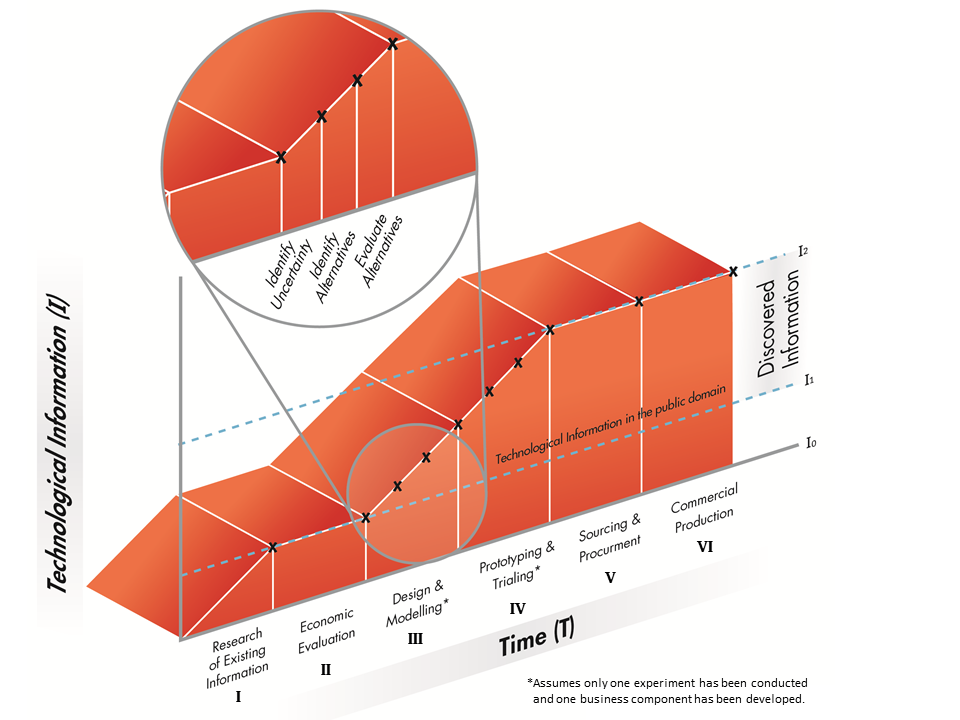
AMSG’s product development lifecycle consists of six distinct phases. Each must be assessed independently for R&D qualification.
1. Initial Market & Literature Review: AMSG’s business development team conducts interviews with potential customers in the medical device industry to assess demand. Simultaneously, a junior researcher reviews existing scientific papers and patents to map the current landscape of biodegradable polymers.
- Assessment: Not Qualifying. This phase constitutes market research and routine data collection, which are explicitly excluded activities.5 The objective is commercial and informational, not the resolution of a specific technical uncertainty.
2. Economic Feasibility Study: AMSG’s finance team develops a detailed financial model to project production costs, pricing strategies, and the potential return on investment for the new polymer.
- Assessment: Not Qualifying. This is a management study focused on the project’s financial viability, another excluded activity.
3. Development of New Polymer Composite: AMSG’s R&D team, led by a PhD in polymer science, begins experimenting with novel chemical formulations to achieve the target specifications for tensile strength and biodegradability, which exceed any commercially available material. The team designs and executes over 50 experimental batches, with many failing to meet the required performance criteria. Each failure provides data that informs the design of the next iteration.
- Assessment: Qualifying. This activity squarely meets all three pillars. The Objective is to create a new product with improved performance. There is significant Technical Risk, as the path to achieving the desired properties is unknown and cannot be resolved by standard engineering. The process is a Systematic, Investigative, and Experimental (SIE) Study, evidenced by the iterative cycle of designing, testing, and analyzing experimental batches.
4. Process Automation & Integration: The new polymer composite has unique thermal properties that require precise temperature control during the extrusion process, beyond the capabilities of AMSG’s existing machinery. The engineering team must develop novel control software and integrate new, highly sensitive thermal sensors into the production line. This integration of software and hardware is a first for the company and presents significant technical challenges in ensuring system stability and process consistency.
- Assessment: Qualifying. This activity qualifies as R&D. While it involves an existing production line, the integration of new hardware with custom-developed software to handle a new material with unknown processing characteristics creates new scientific and technological uncertainties.13 The objective is to create a new manufacturing process, which is a permitted purpose.
5. Routine Quality Assurance (QA) Testing: Once a stable and successful polymer formulation is achieved (from Activity III), the QA team subjects samples from a pilot production run to a series of standard, industry-recognized stress and degradation tests to generate data for regulatory compliance submissions.
- Assessment: Not Qualifying. This is routine quality control testing performed on a finalized product to confirm it meets pre-defined standards. It does not involve the resolution of technical uncertainty.
6. Commercial Production Run: Following successful pilot runs and QA testing, AMSG commences the first large-scale manufacturing of the new polymer for sale to its first customer.
- Assessment: Not Qualifying. This is research conducted after the commencement of commercial production, which is an excluded activity.5 The technical uncertainties have been resolved at this stage.
Detailed Documentation for Qualifying Activities (III and IV)
To successfully claim the R&D tax incentives for Activities III and IV, AMSG must prepare a comprehensive documentation file that substantiates each of the three pillars and quantifies the associated expenditure.
- To Substantiate the Objective Pillar
- To Substantiate the Technical Risk Pillar
- To Substantiate the SIE Study Pillar
- To Substantiate Qualifying Expenditure
- Project Charter / Proposal: A formal document for each activity (Polymer Development and Process Integration) that clearly states the project’s goals. For Activity III, it would specify the target metrics for tensile strength and biodegradability. For Activity IV, it would define the required temperature stability and control precision for the new process.
- Minutes from Project Kick-off Meeting: Official records showing that management reviewed and approved the stated scientific and technological objectives before significant work commenced. These minutes would link the project to the company’s strategic goals.
- Patent Search Results & Literature Review Summary: A report summarizing the initial research (from Activity I, though the activity itself doesn’t qualify) that demonstrates no existing public knowledge or commercially available product meets the project’s technical objectives. This proves the “novelty” aspect.
- Technical Memoranda from Lead Scientist/Engineer: Contemporaneous notes detailing the specific scientific uncertainties. For Activity III, this could be a memo titled “Challenges in Achieving Crystalline Structure in Polymer Blend XYZ.” For Activity IV, it might be “Uncertainty in Sensor Response Time for Real-Time Thermal Feedback Loop.”
- Documentation of Alternative Approaches Considered: Records of brainstorming sessions or internal reports showing that standard, off-the-shelf solutions were evaluated and deemed insufficient, thus necessitating a novel R&D approach.
- Detailed Test Plans: Formal documents outlining the methodology, variables, and success criteria for each experimental batch of the polymer (Activity III) and each iteration of the control software (Activity IV).
- Laboratory Notebooks (Digital or Physical): The most critical contemporaneous evidence. These notebooks should contain dated entries for each experiment, recording the parameters used, observations made, raw data collected, and initial analysis.
- Failure Analysis Reports: For the many failed polymer formulations in Activity III, detailed reports explaining why they failed (e.g., “Batch #27 exhibited poor layer adhesion due to premature curing”). This documentation is powerful evidence of an iterative process and the presence of technical risk.
- Software Development Logs & Version Control History: For Activity IV, records from systems like Git showing the iterative development of the control software, including code comments explaining changes, bug fixes, and the evolution of the control algorithm.
- Employee Timesheets: Digital or paper timesheets where R&D personnel allocate their hours to specific project codes (e.g., “PROJ-POLYDEV” for Activity III, “PROJ-PROCESSINT” for Activity IV) to distinguish qualifying R&D time from other duties.
- Invoices for Consumables: A file of all invoices for raw chemicals, lab supplies, and the specialized thermal sensors. Each invoice should be annotated with the project code to which the materials were allocated.
- Cost Allocation Summary: A master spreadsheet that serves as the bridge between the technical activities and the financial claim. It should list every claimed expense (e.g., salary cost for Scientist A for a specific month, cost of a specific chemical) and link it directly to a qualifying R&D activity (III or IV) and a specific piece of supporting technical documentation (e.g., a lab notebook entry).
The following table provides a condensed, actionable checklist that AMSG can use to organize its documentation file.
| Pillar | Primary Documentation | Secondary/Supporting Documentation |
| Objective | Project Charter / R&D Proposal | Minutes from Project Kick-off and Review Meetings, Business Case (clearly separating commercial vs. technical goals) |
| Novelty / Technical Risk | Technical Specification Document outlining the uncertainties | Patent Search Results, Literature Review Summaries, Memos from Technical Leads, Expert Opinion Letters |
| Systematic, Investigative, & Experimental (SIE) Study | Laboratory Notebooks / Software Development Logs | Detailed Test Plans, Failure Analysis Reports, Progress Reports, Final Technical Report summarizing findings |
| Qualifying Expenditure | Cost Allocation Summary Spreadsheet | Employee Timesheets (with project codes), Invoices for Materials & Consumables, Contracts for Outsourced R&D |
This checklist operationalizes the advice of the entire report. A tax manager can use this structure to create a documentation package that not only meets but anticipates IRAS’s requirements, building a clear, logical, and defensible narrative for the R&D claim.
R&D Tax Credit Preparation Services
Swanson Reed is one of the only companies in the United States to exclusively focus on R&D tax credit preparation. Swanson Reed provides state and federal R&D tax credit preparation and audit services to all 50 states.
If you have any questions or need further assistance, please call or email our CEO, Damian Smyth on (800) 986-4725. Feel free to book a quick teleconference with one of our national R&D tax credit specialists at a time that is convenient for you.
Swanson Reed’s R&D Tax Credit Audit Advisory Services
creditARMOR is a sophisticated R&D tax credit insurance and AI-driven risk management platform. It mitigates audit exposure by covering defense expenses, including CPA, tax attorney, and specialist consultant fees—delivering robust, compliant support for R&D credit claims. Click here for more information about R&D tax credit management and implementation.