
Swanson Reed’s Academic Research
Introduction to Ireland’s R&D Tax Measures
Ireland’s commitment to becoming a global hub for innovation is anchored by a suite of tax incentives designed to reduce the financial burden of R&D. The cornerstone of this policy is the R&D tax credit, a comprehensive framework that significantly enhances the tax benefits available to companies undertaking innovative activities within the country.
The R&D Tax Credit
The Irish R&D tax credit regime provides a 30% credit for qualifying expenditure on qualifying activities for accounting periods commencing on or after January 1, 2024 (previously 25%). This tax credit can be used to reduce a company’s corporation tax liability or can be claimed as a cash refund if the company does not have a liability. This tax credit is applicable to all internal R&D costs incurred from within the European Economic Area (EEA) or the UK, affording a company an effective tax deduction of up to 42.5% (12.5% corporation tax deduction + 30% R&D tax credit).
A crucial feature of the scheme is its refundability. The R&D tax credit is a fully payable credit that is paid in three fixed instalments: 50% of the credit in year one, 30% in year two, and 20% in year three. This is particularly beneficial for startups and SMEs that may be in a pre-profitability phase.
Qualifying R&D and Qualifying Expenditure
To access these benefits, a company’s activities must first meet the statutory definition of R&D. This definition is operationalized through a set of criteria that require a project to be a systematic, investigative, or experimental activity in a field of science or technology, involve basic research, applied research, or experimental development, seek to make a scientific or technological advancement, and involve the resolution of scientific or technological uncertainty.
Once an activity qualifies as R&D, the associated costs must fall under the definition of Qualifying Expenditure. This primarily includes staff costs (salaries and other remuneration for employees directly engaged in the R&D activity), the cost of materials and consumables, and overheads. For R&D outsourced to a third-party service provider, the qualifying expenditure is generally limited to 15% of the company’s overall R&D spend or €100,000, whichever is greater.
The Substantiation Challenge
The central challenge for taxpayers in Ireland lies in substantiating their claims to the satisfaction of the Revenue Commissioners. The Irish system is governed primarily by the Revenue Commissioners’ administrative interpretation. There is no large public repository of tax court rulings on R&D claims that businesses can study. This creates a “documentation vacuum” where taxpayers cannot simply react to established legal standards. Instead, they must proactively construct a robust and logical evidentiary file based on the principles and examples provided in the Revenue Commissioners’ own publications. This report aims to fill that vacuum by providing a practical framework for building such a file.
ARE YOU ELEGIBLE?

WHY CHOOSE US?

PASS AN AUDIT?

A Detailed Analysis of the Qualifying R&D Rules
The eligibility of any R&D tax claim in Ireland hinges on whether the underlying project satisfies the qualifying criteria. Each criterion must be met and, more importantly, documented. A failure to substantiate any one of these can jeopardize the entire claim.
Systematic, Investigative, or Experimental Activities in a Field of Science or Technology
The first pillar requires that the project’s activities are conducted in a structured and methodical manner within a scientific or technological field. This distinguishes genuine R&D from ad-hoc problem-solving or random trial and error. The work must follow a logical progression based on a plan, and the activities must be designed to explore and uncover new information to resolve the technical uncertainties.
Basic Research, Applied Research, or Experimental Development
This pillar requires the R&D to fall into one of three categories:
- Basic research: Experimental or theoretical work undertaken primarily to acquire new scientific or technical knowledge without a specific practical application in view.
- Applied research: Original investigation undertaken in order to acquire new scientific or technical knowledge and directed towards a specific practical aim or objective.
- Experimental development: Work that draws on existing knowledge gained from research or practical experience, that is directed to producing new materials, products or devices, to installing new processes, systems and services, or to improving substantially those already produced or installed.
Scientific or Technological Advancement and Resolution of Scientific or Technological Uncertainty
This is arguably the most critical and often the most challenging pillar to substantiate. The project must seek to achieve a scientific or technological advancement and involve the resolution of a scientific or technological uncertainty. This concept is defined by the Revenue Commissioners as an uncertainty that cannot be readily resolved by a competent professional in the relevant field.
This definition sets a high bar. It is not enough for a project to be new to the company or even new to Ireland if the solution is readily deducible using existing knowledge and standard industry practices. The core of this pillar is the presence of genuine uncertainty.
Specifically Excluded Activities
To provide clarity and prevent the misapplication of R&D incentives to routine business operations, the Revenue Commissioners’ guidance implicitly excludes several activities that do not qualify as R&D, even if they are conducted in support of a broader innovation agenda.
Understanding these exclusions is critical for accurately scoping a claim and avoiding potential disputes with the Revenue Commissioners.
The primary excluded activities are:
- Routine testing and analysis of materials, components and products.
- Activities that do not involve a systematic approach, such as ad hoc problem solving.
- Work to develop non-scientific or non-technological aspects of a new or improved material, device, product or process.
- The repositioning of an existing product or service in a new market, or the development of a new market for an existing product or service.
NEVER MISS A DEADLINE

STAY UP TO DATE ON IRS PROCESS

DISCOVER R&D IN YOUR INDUSTRY

Revenue’s Focus on Substantiation: An Analysis of Administrative Guidance
In the absence of a large public body of tax court precedents for R&D claims in Ireland, taxpayers must look to the Revenue Commissioners’ administrative pronouncements and frameworks to understand its expectations for substantiation.
The Revenue’s “Tax and Duty Manual Part 29-02-03”
The foundational text for any R&D claim is the Revenue’s “Tax and Duty Manual Part 29-02-03.” This manual is the primary source of official interpretation, providing detailed explanations of the qualifying criteria, definitions of qualifying expenditure, and illustrative examples. Taxpayers and their advisors should treat this manual as the starting point and primary reference for structuring their R&D claims and documentation.
Insights from Irish Case Law
As previously noted, Ireland’s R&D tax framework is primarily shaped by the administrative guidance of the Revenue Commissioners rather than an extensive body of public court rulings. However, tax appeal cases provide valuable insights into the judiciary’s approach and the importance of compliance.
113TACD2022 – The Importance of Timely Filing
A 2022 Tax Appeals Commission decision, 113TACD2022, highlights the strictness of the statutory time limits for R&D tax credit claims. In this case, the appellant missed the 12-month deadline for submitting their R&D credit claim and the Revenue Commissioners refused the claim. The Appeal Commissioner upheld the Revenue’s decision, emphasizing that the statutory time limit is mandatory and there is no room for discretion, even if the late submission was the fault of the taxpayer’s agent. This case underscores the critical importance of adhering to procedural requirements when making an R&D tax credit claim.
Case Study: Advanced Materials IRL Ltd.
To synthesize the principles discussed, this section presents a practical case study of a hypothetical Irish SME, Advanced Materials IRL Ltd. (AMIRL). AMIRL operates in the advanced manufacturing sector and is developing a new, high-strength, biodegradable polymer composite for use in high-performance medical devices.
Analysis of Activities
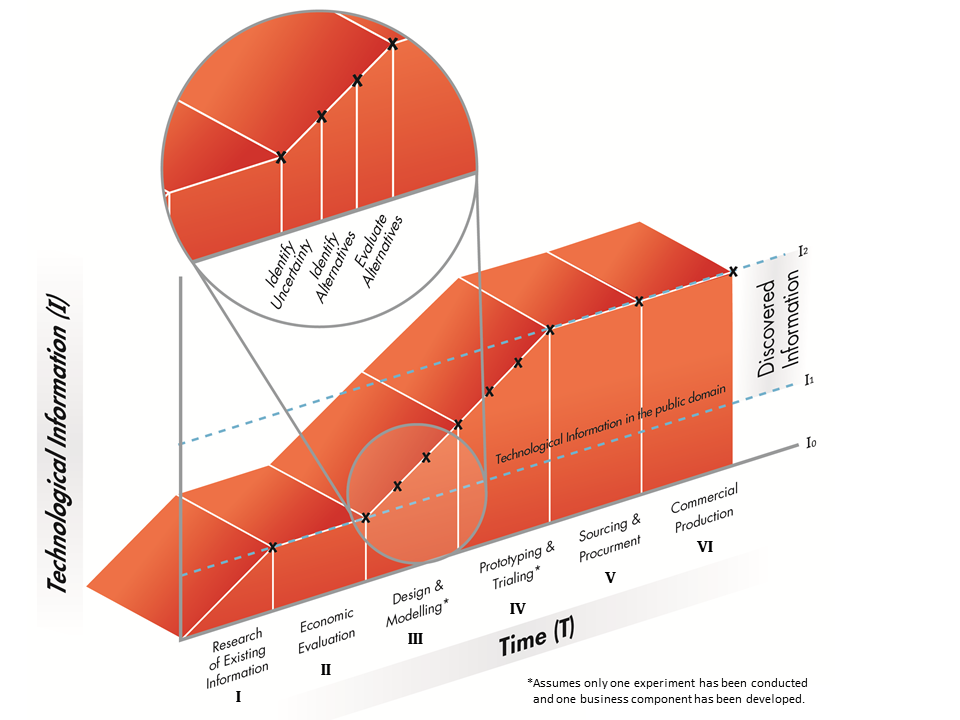
AMIRL’s product development lifecycle consists of six distinct phases. Each must be assessed independently for R&D qualification.
1. Initial Market & Literature Review: AMIRL’s business development team conducts interviews with potential customers in the medical device industry to assess demand. Simultaneously, a junior researcher reviews existing scientific papers and patents to map the current landscape of biodegradable polymers.
- Assessment: Not Qualifying. This phase constitutes market research and routine data collection.
2. Economic Feasibility Study: AMIRL’s finance team develops a detailed financial model to project production costs, pricing strategies, and the potential return on investment for the new polymer.
- Assessment: Not Qualifying. This is a management study focused on the project’s financial viability.
3. Development of New Polymer Composite: AMIRL’s R&D team, led by a PhD in polymer science, begins experimenting with novel chemical formulations to achieve the target specifications for tensile strength and biodegradability, which exceed any commercially available material. The team designs and executes over 50 experimental batches, with many failing to meet the required performance criteria. Each failure provides data that
informs the design of the next iteration.
- Assessment: Qualifying. This activity squarely meets all the qualifying criteria. It is a systematic, investigative, and experimental activity in the field of science, seeking to achieve a technological advancement by resolving a technological uncertainty.
4. Process Automation & Integration: The new polymer composite has unique thermal properties that require precise temperature control during the extrusion process, beyond the capabilities of AMIRL’s existing machinery. The engineering team must develop novel control software and integrate new, highly sensitive thermal sensors into the production line. This integration of software and hardware is a first for the company and presents significant technical challenges in ensuring system stability and process consistency.
- Assessment: Qualifying. This activity qualifies as R&D. While it involves an existing production line, the integration of new hardware with custom-developed software to handle a new material with unknown processing characteristics creates new scientific and technological uncertainties.
5. Routine Quality Assurance (QA) Testing: Once a stable and successful polymer formulation is achieved, the QA team subjects samples from a pilot production run to aseries of standard, industry-recognized stress and degradation tests to generate data for regulatory compliance submissions.
- Assessment: Not Qualifying. This is routine quality control testing.
6. Commercial Production Run: Following successful pilot runs and QA testing, AMIRL commences the first large-scale manufacturing of the new polymer for sale to its first customer.
- Assessment: Not Qualifying. This is research conducted after the commencement of commercial production.
R&D TAX CREDIT TRAINING FOR CPAS

R&D TAX CREDIT TRAINING FOR CFPS

R&D TAX CREDIT TRAINING FOR SMBS

A Practical Documentation Example
To successfully defend its claim, AMIRL needs to create contemporaneous documentation that tells the story of its innovation journey. The primary document is often a Project Technical Narrative. Below is a filled-in example for the qualifying Activity III.
R&D Project Documentation Form
| Project Title: | Development of a High-Strength, Biodegradable Polymer Composite for Medical Devices |
| Project ID: | AMIRL-R&D-2025-001 |
| Project Timeline: | 5 January 2025 – 30 November 2025 |
| Project Lead: | Dr. Aoife Murphy (Lead Scientist, Polymer Science) |
| Field of Science/Technology: | Materials Science, Polymer Chemistry |
- 1. Project Objective
- 2. Scientific or Technological Advancement Sought
- 3. Scientific or Technological Uncertainty
- 4. Systematic, Investigative, and Experimental Approach
- 5. Supporting Documentation Checklist
What was the overall goal of the project?
The primary objective was to formulate, synthesize, and test a new polymer composite material intended for use in high-performance medical devices. The goal was to create a material that is both mechanically superior to existing biodegradable polymers and fully biodegradable within a specific timeframe, addressing a key market need for strong, single-use surgical instruments that are also environmentally sustainable.
What advancement in the overall field of science or technology did this project aim for?
The project sought to achieve a significant technological advancement over the current global state-of-the-art. The existing baseline for biodegradable polymers (like Polylactic Acid, PLA) shows a trade-off: high strength is typically associated with slow degradation, while faster-degrading materials lack the mechanical integrity for demanding applications.
The targeted advancement was the creation of a new class of polymer composite that simultaneously exhibits:
- High Tensile Strength: Greater than 150 MPa.
- Controlled Biodegradability: At least 90% degradation in a composting environment within 180 days.
This combination of properties was not known to be achievable based on publicly available knowledge at the project’s outset.
What specific technical challenges did you face that could not be readily resolved by a competent professional in the field?
At the beginning of the project, it was uncertain if the dual objectives could be met. The core uncertainties were:
- Chemical Formulation Uncertainty: It was unknown how to blend base polymers with novel plasticizers to create a stable molecular structure that would provide high strength, yet break down predictably.
- Process Uncertainty: It was uncertain how the new formulations would behave under standard melt extrusion processes, potentially requiring a new processing methodology.
- Sterilization Stability Uncertainty: It was uncertain whether the final material could withstand common sterilization methods without compromising its mechanical or biodegradable properties.
These uncertainties required a systematic program of experimentation to resolve.
Describe the methodical approach, experiments, and tests you conducted to overcome the uncertainties.
We undertook a structured experimental program:
1. Hypothesis Formulation: We hypothesized that a specific ratio of PLA to PHA, combined with a proprietary additive, could create a stronger matrix that would also be susceptible to hydrolysis.
2. Experimental Design: A Design of Experiments (DoE) model was created to test 50+ unique formulations.
3. Iterative Testing & Analysis: Each batch was synthesized and then subjected to a testing protocol:
- Mechanical Testing (ISO 527): For tensile strength.
- Degradation Testing (ISO 14855): To measure the rate of biodegradation.
4. Data-Driven Refinement: The results of each batch were recorded in lab notebooks. Batches that failed provided critical data that informed the formulation of subsequent batches, leading to the resolution of the initial uncertainties.
List of associated documents providing evidence for the claims made above.
● [✓] Project Initiation Document & Plan (PID-AMIRL-2025-001)
● [✓] Lab Notebooks (Ref: LN-2025-P1 to P5)
● [✓] Raw Data from ISO 527 and ISO 14855 tests
● [✓] Staff Timesheets allocated to Project ID AMIRL-R&D-2025-001
● [✓] Invoices for polymer resins and chemical catalysts
● [✓] Interim and Final Technical Reports summarizing findings
Financial Breakdown & Tax Credit Calculation
The following table details the costs incurred by AMIRL for its qualifying R&D project and calculates the potential tax benefit.
| Cost Category | Description / Breakdown | Total Cost (€) | Qualifying R&D Expenditure (€) |
| Staff Costs | Dr. Murphy (Lead Scientist, €80k salary, 80% time) |
€ 64.000,00 | € 64.000,00 |
| Lab Technician 1 (€45k salary, 100% time) |
€ 45.000,00 | € 45.000,00 | |
| Lab Technician 2 (€45k salary, 100% time) |
€ 45.000,00 | € 45.000,00 | |
| Process Engineer (€65k salary, 50% time) |
€ 32.500,00 | € 32.500,00 | |
| Subtotal | € 186.500,00 | € 186.500,00 | |
| Materials | Polymer resins, catalysts, and other chemicals for 50+ experimental batches |
€ 50.000,00 | € 50.000,00 |
| Subtotal | € 50.000,00 | € 50.000,00 | |
| Overheads | Allocated portion of light, heat, and rent for the laboratory space (15% of R&D staff costs) |
€ 27.975,00 | € 27.975,00 |
| Subtotal | € 27.975,00 | € 27.975,00 | |
| Total | € 264.475,00 | € 264.475,00 | |
| Tax Credit Calculation | |||
| Total Qualifying Expenditure |
€ 264.475,00 | ||
| R&D Tax Credit @ 30% |
(€264,475 x 30%) | € 79.342,50 | |
| Corporation Tax Deduction @ 12.5% |
(€264,475 x 12.5%) | € 33.059,38 | |
| Total Effective Tax Benefit |
(Credit + Deduction) | € 112.401,88 | |
Calculation Analysis:
The total tax benefit amounts to €112,401.88, which represents a 42.5% effective relief on the company’s R&D investment. This significantly reduces the net cost of innovation for AMIRL.
R&D Tax Credit Preparation Services
Swanson Reed is one of the only companies in the United States to exclusively focus on R&D tax credit preparation. Swanson Reed provides state and federal R&D tax credit preparation and audit services to all 50 states.
If you have any questions or need further assistance, please call or email our CEO, Damian Smyth on (800) 986-4725. Feel free to book a quick teleconference with one of our national R&D tax credit specialists at a time that is convenient for you.
Swanson Reed’s R&D Tax Credit Audit Advisory Services
creditARMOR is a sophisticated R&D tax credit insurance and AI-driven risk management platform. It mitigates audit exposure by covering defense expenses, including CPA, tax attorney, and specialist consultant fees—delivering robust, compliant support for R&D credit claims. Click here for more information about R&D tax credit management and implementation.